What is the relationship between letter Bet that we have already hinted upon[1] and the sonnet poem Correspondances by Charles Baudelaire , the perfume Channel No 5 and the design of the leading hotels of the world?
Let’s start by saying they all have the same semantic root, number 5 [2]in line with the Hebrew three consonant roots ( the shoresh) , out of which bloom words with interrelated meaning . We are going to touch upon such an accord today like a feather, veiled and we will deliver its layered essence through a post which is yet to come .
World class design is very much related to the heart notes of number 5. Delving into the elegant world of the best hotels of the world, when it comes to the culture of the country in which they are placed, it is presented as distilled essence.
When we say that the culture is distilled we are thinking in terms of perfume elixir. The accord of the heritage (the depth notes), the emotional temperature (the heart notes) and the style (the top notes) of a country is stripped of superficial elements and it is it presented as a pure essence.
This could be interpreted as a cultural echo, that we have already talked about through hotel Aman Tokyo ( section Hidden) as well as a translation of the country’s culture into a felt synesthetic experience. The best hotels of the world don’t quote a culture by presenting cultural motifs , rather they invite us to perceive what the Japanese, Greek, Moroccan, French, Tunisian and so on culture feels like.
To show case such design brilliance, I will refer to the interior design of a leading hotel of the world in Tunisia namely the
Before pondering over the emotional atmosphere of the hotel, let’s discuss distilled cultural codes of Tunisia. I have been there, I had a marvelous time, I really enjoyed the seamless integration of desert and sea as well as the warm hospitality of the locals . Having said this, I will zoom in and discuss just one cultural code which is emblematic of the culture as a whole. In poetry , a single word can carry multiple layers of interpretation, this is called polysemy , and the beauty of it all if felt at a subliminal level as the multiplicity of information bypasses logical interpretation . Since my aim is to focus on the resonance of the hotel, this approach seems relevant.
When it becomes to cultural distillation Light ( with a capital L) in Tunisia is modulated, This cultural code is very much related to the history and mentality of the country.
To begin with:
Ontological spiritual Light
In Tunisia relationship with God is built on partial revelation , the same way that happens in the Hebrew tradition , not to mention the diagonal relationship between the levels of reality exemplified in posts about letter Aleph and cultural echo – Aman Tokyo. To live with Light wisely, is to live in harmony with the sacred rhythm of divine manifestation and concealment.
Tunisia carries a history of synthesis
It has been inhabited by Phoenicians, Romans, Byzantines, Arabs , Ottomans and the French, yet instead of being fragmented by this process it has learned to place them into fruitful dialogue , not in a state of aggressive fusion .
A civilization of interiors
While the Mediterranean sun is dazzling, Tunisian tradition turns inwards , to patios, riads, hammams and shaded arcades. Historically, even spiritually just like the Hebrew tradition I think this reflects a life lens of protection and introspection . Just like the Hebrew Torah story of vessels, where the first vessels where shattered because they couldn’t handle the intensity of divine Light, beauty in Tunisia doesn’t depend on exposure but on containment and reflection. This is very much related to poetry as well as fashion and eloquence that shines under what is hidden rather than what is revealed.
Hospitality in Tunisia is not only a custom , it is choreography of Light . Refracted Light in the design of the leading hotels of this country and the world in general , mirrors the way guests are received – everything is done with gentleness , discretion and measured warmth. It is not intrusive the same way that passion in the culture is contained. This could very much relate to inter alia its French traces which focuses on restrained elegance as an epitome of eloquence – class.
Synethesia and La Badira Light
What is brilliant about the design of this hotel is the way this Light is presented as an echo through the synesthetic fusion of the senses :
When it comes to vision :
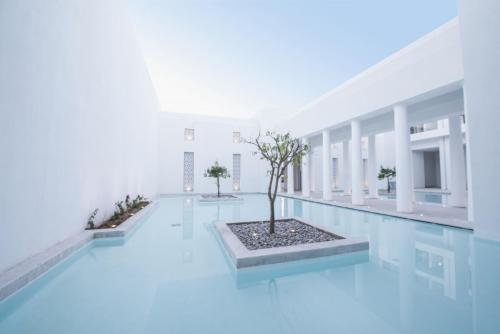
to begin with La Badira is an oasis of white. Every surface from the alabaster walls, to the linen to the luminous marble seems to breathe light rather than reflect it . Instead of dazzling the gaze, it absorbs it and allows perception to unfold in layers. Vision is not immediate or total.
- Depending on the hour, the angle and the observer’s position , white changes from cool to warm, opaque to translucent, hence perception literally unfolds , it is dynamic – Tunisian Light is porous not fixed;
- On another interrelated standpoint, the architecture guides the gaze through a sequence of white corridors , where Light is tamed and disciplined . The corridors are not merely passages, they are emblems of mediation;
- Along these corridors and into the room hang patterned lanterns which filter Light, whose pierced akin transforms luminosity into delicate geometry . Nothing is fully shown, everything is suggested, refracted , an act of contemplation ~~
Scent as atmosphere of Light
Hotel La Badira is discreetly scented by orange blossoms, jasmine, cedar and sea salt.
These mirror dynamic Light qualities.
Orange is associated with feminine luminosity , the morning light tender unfolding, jasmine embodies evening sensuality, twilight, cedar plays with shadows while sea salt represents freshness, the breeze of the noon Light.
Touch
The linens are weightless, stucco, sand and stone carry the memory of heat , the marble floors are cool to the skin, it feels like light turned into silence , walls of chalky plaster are soft as powdered stone.
Every material whispers of light held in discipline ^
Sound as emotional resonance
At La Badira sound is never intrusive. Every sound , the muted footsteps along the marble corridors, the faint rustle of linen curtains, the distant rhythm of the sea move as if through a prism , traveling softly along the white surface absorbed and then released . In this respect echo becomes design, silence transforms into contained luminosity the equivalent of Hebrew letter Aleph which is silent but pregnant with infinite potential~~~
Culinary excellence
Just like architecture filters sunlight through latticed screens and white marble, the culinary language filters brightness through texture and taste. Citrus glows like a restrained surprise, saffron, honey and olive oil shimmer beneath surfaces , they suggest rather than reveal . The essence is veiled the same way that Arabic and Hebrew letters conceal spiritual essence behind from .
On another note the various cultural backgrounds of Tunisia flirt with each other playfully resulting in culinary flow where French refinement is softened by North African warmth , geometry meeting generosity . The cuisine embodies the spiritual choreography and hospitality of Tunisia , inward contemplative – a fusion that doesn’t overwhelm instead whispers brilliance.
Baudelaire’s poem Correspondances – the hotel as living poem
When the senses flirt and meet you cannot tell where illumination ends and aroma or flavour begin. In this respect the aura of the hotel centers around the notion of correspondance beautifully presented in the respective Baudelaire poem.
In this poem Baudelaire imagines Nature as a temple where everything is alive and semiotic. Each thing , each scent , sound or form is a symbol pointing to something beyond itself. His Universe is a set of correspodances , a visbile world that echoes the invisible.
In the same respect La Badira functions exaclty as such a temple where walls, scents and textures become living pillars translating divine and/or cultural essence . The hotel is a microcosm of Tunisia .
The poem sings however, the moment the senses fuse like when he says that:
there are perfumes fresh as children’s flesh
soft as oboes, green as medows
and others corrupt rich and triumphant
which sing the rapture of soul and sense
In the same way the beauty of the hotel is not to be found in the manifestation of individual senses but in their conversation, just as we will examine the accord between Hebrew, French and Greek languages which produces an elixir acting as an archetype through which reality might be perceived and lived.
~~~~~~~~~~~~~~~~~~~~~~~~~~~~~~~~~~~~~~~~~~~~~~~~~~~~~~~~~~~~~~~~~~~~~~~~~~~~~~~~
Fragnance note:
World: Visible – Light becomes architecture
Dominant language : Hebrew – inwardness light as revelation, symbolic meaning of senses
Echoes: Greek clarity, geometric purity, French the art of whispered brilliance and refinement
Sillage : the synesthetic correspondance , a tender luminosity.
~~~~~~~~~~~~~~~~~~~~~~~~~~~~~~~~~~~~~~~~~~~~~~~~~~~~~~~~~~~~~~~~~~~~~~~~~~~~~~~~
[2] All words are related to number 5. For each word we take the vowels and we give them a numerical value based on their order in the English alphabet. a is 1 , o is 15 and so on. Then we add all vowels , if we get a 2 digit number we add again till we have a one digit number. The words that carry the same number could be semantically related~~
5 Responses
A wonderful article, reminiscent of a poem — much like Baudelaire’s “Correspondances,” which you so beautifully described at the end. Your writing feels like a hymn to light — its dimensions, its energy, its sensations — and to the way these unfold and transform across different cultures.
Many thanks for the kind words Kalliopi!
Many thanks for the kind words Kalliopi! Much appreciated
Christina, your words breathe like light upon marble — tender, fragrant, eternal. Each image shimmers between silence and sound, where beauty whispers rather than declares. A love letter to harmony itself.
I really appreciate your wonderful words Baggeli-) Very grateful that you took the time to read my article